.:The Framework Customization Model (1/3):.
The overall goal of the FCM is to provide framework users
with active and passive assistance while creating framework
customization. To make this assistance possible, the framework
developer has to provide the framework with its structural
dependencies also called consistency model.
The structural dependencies
Structural dependencies capture framework usage constraints that
must be respected when a customization is done by the framework
user. On a pragmatic point of view, structural dependencies are relations binding two
or more heterogeneous elements of a framework (class, method,
file, etc.) in the way that if an action is done on one element
(creation/deletion/modification) an action should be done on the
others.
In order to show an example of what structural dependencies are,
we use the EJB framework (which allows to build distributed Java
components) to create an EJB component called Account.
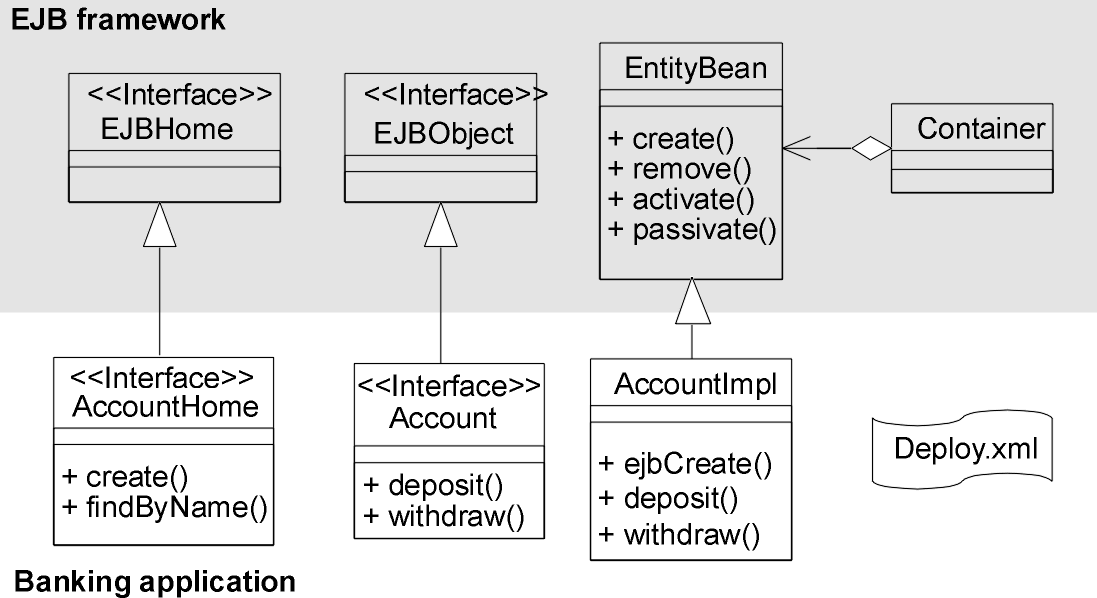
The resulting customization will
be correct if the following constraints are respected:
- Account, the component interface, must implement the framework interface
EJBObject. AccountImpl, the implementation of the account component, must extend
EntityBean. AccountHome, the factory for the account component, must implement EJBHome
-- Here the constraints are on the inheritance relationship.
- AccountImpl must implement all methods from Account because AccountImpl does not implement Account -- Here
there is a constraint on the addition of methods.
- AccountImpl must contain one ejbCreate
method per creation method on AccountHome, the factory. The
framework will manage the correspondence between the specification
in the interface and the implementation in the class following
naming constraints.
- Last but not least, a file named deploy.xml must be filled with the name
of all the classes created -- This shows that dependencies can be
among heterogeneous elements.
From this shorten example that could have been extracted from a
cookbook, one can guess that dealing with those dependencies is
burdensome and error prone if no help is provided. Those errors
are even more tricky to find when they are not caught before
runtime. A user may expect assistance and verification
facilities based on a language independent (XML file, Java elements, ...) model allowing
reasoning on non-existing elements. It is to fulfill these goals
that the FCM model has been developed.
next page
|